

Recognition means more when you can trace it back to the work, the people and the purpose behind it.
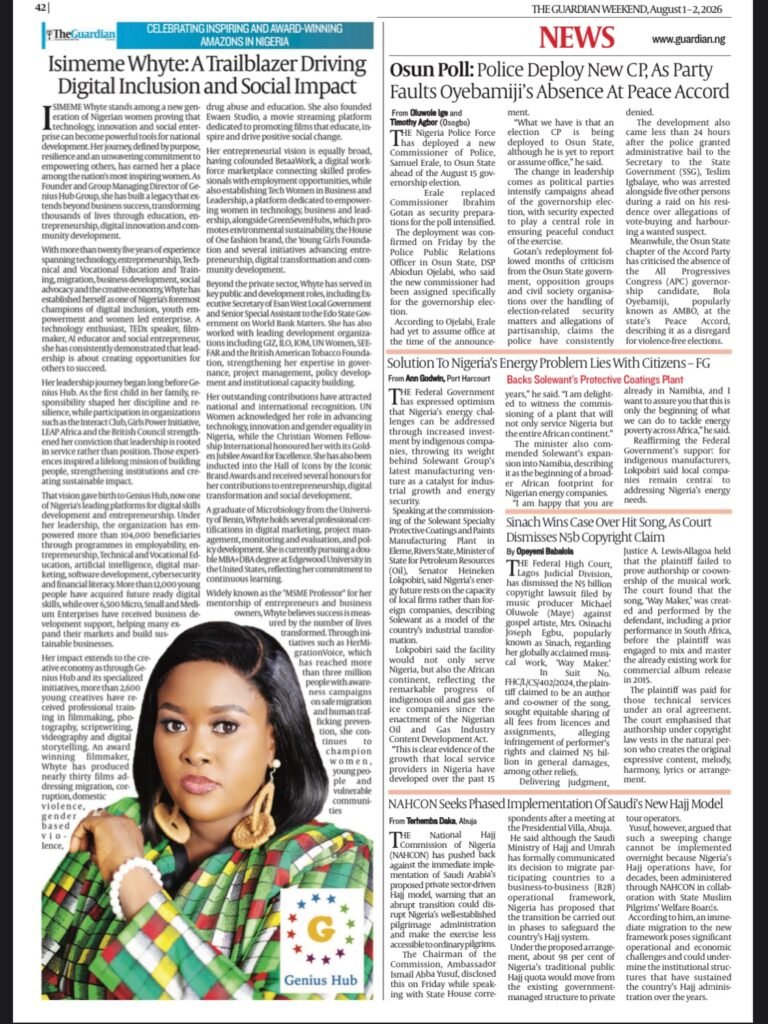
When I saw my name featured in The Guardian Weekend edition of August 1–2, 2026, as one of “100 Inspiring and Award-Winning Amazons in Nigeria,” I was reminded that meaningful work is not always measured by how quickly it gets noticed, but by the lives it touches and the opportunities it creates along the way.
The feature, published by The Guardian’s Special Projects Unit, also profiled me under the headline, “Isimeme Whyte: A Trailblazer Driving Digital Inclusion and Social Impact.”
I am grateful for this recognition. It is an honour to be included among accomplished Nigerian women whose work continues to contribute to their industries, communities and the country at large.
But for me, this recognition represents something bigger than an individual achievement.
It speaks to a journey that has been shaped by a commitment to people, a belief in the power of skills, and a determination to make opportunities more accessible to those who need them.
It also reflects the work we continue to do at Genius Hub Group.
Beyond Recognition: The Work That Matters to Me
Over the years, my journey has taken me across technology entrepreneurship, technical and vocational education and training (TVET), digital skills development, business development, migration-related social advocacy, women and youth empowerment, and the creative economy.
These areas may appear different on the surface, but they share a common thread: people need more than potential to thrive. They need the skills, opportunities, support and environment to turn that potential into something meaningful.
I have always believed that talent exists everywhere, but access to opportunity is not always equally distributed.
There are young people with the capacity to build remarkable careers who simply need access to relevant training. There are women with entrepreneurial ideas who need the right support to turn those ideas into sustainable businesses. There are small business owners with the ambition to grow but without the systems, digital tools or business knowledge to take their enterprises to the next level.
There are individuals who need a second chance, communities that need stronger support systems, and people whose abilities have not yet been matched with the right opportunities.
These realities continue to shape the work I do.
They remind me that development cannot stop at identifying people’s potential. We must create practical ways for them to use it.
Why I Built Genius Hub
At Genius Hub Group, our work is rooted in a simple conviction: people should be able to turn what they learn into opportunities that improve their lives.
We work across skills development, digital inclusion, TVET, entrepreneurship, innovation, youth and women empowerment, MSME development, and the creative economy because we understand that sustainable development requires more than one intervention.
A person may need technical skills to become employable. Another may need digital knowledge to grow an existing business. Someone else may need entrepreneurial support to move from earning an income to building an enterprise.
The pathways may differ, but the goal remains the same: to help people develop the capacity to participate meaningfully in the economy and contribute to their communities.
For me, Genius Hub is not simply about training people. It is about building a connected ecosystem in which learning can lead to practice, practice can lead to opportunity, and opportunity can create lasting impact.
That distinction matters.
Training someone is important, but what happens after the training is just as important. Can they apply what they have learned? Can they access opportunities? Can they earn an income? Can they build a business? Can they employ others? Can they use their skills to solve problems within their communities?
These are the questions that should guide human capital development.
We Don’t Just Train People. We Build Pathways.
One of the ideas that captures our approach at Genius Hub is the journey from potential to impact.
Potential → Skills → Practice → Opportunity → Income → Enterprise → Impact.
Every stage matters.
Potential is the starting point, but it must be nurtured. Relevant skills provide the foundation, while practice helps people build the confidence and competence to apply what they know.
Access to opportunity allows those abilities to meet real needs. From there, people can earn an income, establish businesses, create jobs and contribute to wider economic and social development.
This is why I believe skills development must be connected to the realities of the marketplace.
We cannot keep training people without asking what happens when they finish. We cannot celebrate the number of people who have attended a programme without considering whether they can apply their learning. And we cannot speak about empowerment without examining whether people have the resources and opportunities to become more independent.
At Genius Hub, we continue to work towards making these connections stronger.
Our vision is not simply to produce more trained individuals. It is to support people in building livelihoods, developing enterprises and participating in an economy where their abilities can create value.
Digital Inclusion Must Lead to Real Opportunity
The Guardian’s decision to profile my work around digital inclusion and social impact speaks to two areas that I believe are increasingly connected.
Digital technology is changing how people learn, work, communicate, market products, manage businesses and access services. For young people, entrepreneurs and small businesses, digital capabilities can open doors that were previously difficult to reach.
But access to technology alone is not enough.
People must know how to use it. They need relevant skills, practical experience and the confidence to apply digital tools to real problems.
For an entrepreneur, this might mean using digital platforms to reach new customers, improve business operations or manage information more effectively. For a young person, it could mean developing digital competencies that improve employability or open up new career paths. For a creative, it might mean using technology to produce, distribute and monetise original work.
Digital inclusion becomes meaningful when people can translate access into participation and participation into opportunity.
That is why our work must continue to focus on practical learning, innovation and the connections that help people use technology productively.
The question is not merely whether people have access to the digital economy. It is whether they have the capacity to participate in it and benefit from it.
Empowering Women Means Expanding Their Options
Being recognised among Nigeria’s inspiring and award-winning Amazons is especially meaningful because the conversation about women’s empowerment is one that deserves continued attention.
Across communities, women possess knowledge, talent, creativity and entrepreneurial ability. Yet many still face barriers to accessing skills, resources, markets and opportunities.
Empowerment must therefore go beyond encouragement.
It must include practical skills, access to relevant information, entrepreneurial support, digital capabilities and opportunities to participate in economic life.
When a woman develops a skill that enables her to earn an income, the impact can extend beyond her individual circumstances. It can strengthen her choices, support her household and create new possibilities for the people around her.
When women build sustainable businesses, they can also become employers, mentors and contributors to local economic growth.
This is why women’s empowerment should not be treated as a separate conversation from economic development. It is part of how we build stronger businesses, more resilient households and more inclusive communities.
For me, the work is about helping create conditions in which more women can turn their abilities into sustainable opportunities.
The Connection Between Skills, Enterprise and Social Impact
My experience across business development, skills training and social advocacy has reinforced an important lesson: the challenges people face are often interconnected.
A lack of employable skills can limit economic options. Limited economic options can make individuals and families more vulnerable. Weak business support systems can prevent entrepreneurs from growing. Inadequate access to opportunities can leave capable people excluded from the very systems that could help them thrive.
This is why lasting impact requires a broader approach.
Skills development must connect with employability. Entrepreneurship must connect with business support. Digital learning must connect with practical application. Social interventions must consider the conditions people need to rebuild their lives and participate meaningfully in their communities.
We must look beyond isolated activities and pay attention to the pathways connecting them.
That is the thinking behind the Genius Hub ecosystem: creating opportunities for people to learn, develop, build and contribute.
It is also why I see human capital development as an important part of sustainable development. When people are equipped to participate productively in the economy, the benefits can extend to businesses, families, communities and future generations.
A Recognition That Belongs to a Bigger Vision
While I am honoured by this feature in The Guardian Weekend, I also recognise the people and collective effort behind the work.
No meaningful organisation is built by one person alone. It takes people who believe in a vision, teams who turn ideas into action, partners who open doors, trainers who share their knowledge, and beneficiaries who put what they have learned into practice.
It takes collaboration, patience and a willingness to keep improving.
This recognition is therefore an opportunity to acknowledge the broader work happening through Genius Hub Group and to reaffirm our commitment to the people and communities we serve.
It is also a reminder that there is still more to do.
There are more young people to equip with relevant skills. More women to support in building sustainable livelihoods. More entrepreneurs to help strengthen their businesses. More opportunities to create through technology, innovation and the creative economy. And more communities that can benefit when skills, enterprise and social impact work together.
That is the work that continues to motivate me.
Looking Ahead: From Recognition to Greater Impact
I am grateful to The Guardian’s Special Projects Unit for the recognition and for including me among the 100 inspiring and award-winning Amazons in Nigeria.
I receive this honour with gratitude, but also with a renewed sense of responsibility.
Recognition is encouraging, but the real work continues beyond the headlines.
It is in the young person who acquires a skill and finds a meaningful opportunity. It is in the woman who turns her knowledge into a sustainable source of income. It is in the entrepreneur who strengthens a business and creates employment for others. It is in the community that becomes more resilient because people have access to the support and opportunities they need.
These are the outcomes that make the work worthwhile.
And they are the outcomes I want us to keep building towards at Genius Hub Group.
My conviction remains simple: when people are equipped with the right skills, supported with the right opportunities and connected to the right ecosystem, they can create meaningful and measurable change.
That is why we will continue to invest in skills, innovation, entrepreneurship, digital inclusion and human capital development.
Because ultimately, the goal is not simply to train people.
It is to help people build better futures, create sustainable livelihoods and contribute to a society where more people have the opportunity to thrive.
Recognition celebrates the journey so far. Impact determines what the journey makes possible next.
And for me, the work continues.
-Isimeme Whyte
